
Seeing Like a Feminist
By Amruthavarshini
Research Intern, Jindal Centre for the Global South, O.P. Jindal Global University, India
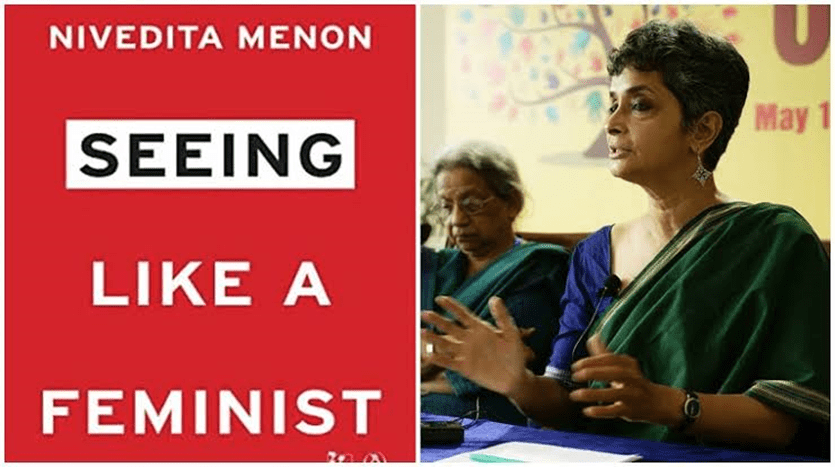
About the Author and the Book
Nivedita Menon is a writer and an influential feminist academic, who briefly taught at Lady Shri Ram College, University of Delhi, and is currently a professor of political science at Jawaharlal Nehru University, New Delhi. Her work Seeing Like a Feminist is one of the finest works written on feminism. Published by Zubaan and Penguin Books India in the year 2012, the same year as the gruesome Nirbhaya gang rape happened. The book is an astonishingly brilliant basic primer to the feminism of the Global South.
While Menon’s writing is insightful and thought-provoking, it can also be dense and academic at times. Some readers may find her arguments difficult to follow or overwhelming. Additionally, while the book covers a wide range of topics related to feminism in India, it can sometimes feel disjointed.
Compared to other books on feminism in India, “Seeing Like a Feminist” stands out for its intersectional approach to feminism. Menon does an excellent job of examining how issues of gender intersect with other forms of oppression, such as caste, class, and religion. This sets the book apart from other works on Indian feminism that may focus solely on gender without considering these other factors. I would highly recommend “Seeing Like a Feminist” to anyone interested in feminism or social justice in India.
Book Review
Gloria Steinem, whom Menon quotes twice in this book, compared intersectionality to a patchwork quilt in an interview. We are a group of discrete yet connected patches in various colors and designs (Tilotama Productions, 2015). The topics discussed include the division of labour between the sexes, marriage, issues pertaining to the LGBTQ community (Menon, 2012, p.97), moral dilemmas surrounding pornography, sex work and abortion, rape – marital and otherwise (p.139), domestic violence, the effects of caste-based discrimination the concept of physical labour in the context of capitalism and feudalism, and the subtle nuances of words like “agency,” “choice,” “freedom,” “commodification” (p.175).
The book is divided into six primary chapters—Family, Body, Desire, Sexual Violence, Feminists and Women, Victims or Agents— which address the bigger challenges in India. Each chapter makes a reference to how patriarchy affects women’s lives in India and how the problems eventually relate to women’s lack of autonomy and choice in the country. Menon uses various examples and stories to illustrate each topic in the book, which is a significant factor as it gives the reader a background on the issues. To explain the hows and the whys of feminism and offer us a complete picture of what it means to be a feminist, each chapter is packed with instances of social realities from all over the nation.
Menon argues that feminism is not just about women but also about acknowledging that class, caste, and queer politics further complicate the concept of “gender,” making the term “women” unstable and heterogeneous (p.149). Recognizing the dominant social influence at play in each situation and analyzing how it worsens gender-based challenges are central to feminism. The goal is to acknowledge that men and women experience the world in different ways and that there is no single, universal female experience. Instead, there are a variety of factors that interact to create a difference between male and female realities, and each woman is also subject to additional changes in her worldview depending on her social status.
Menon broadens the view of feminism by introducing intersectional feminism in the context of India. The author examines the fight for equality against the prevailing social structure by demonstrating how discriminatory social norms affect every aspect of our lives, such as how we perceive sex, desire, and the human body, which affects how we perceive “men” and “women” and their respective social roles. Menon criticizes several social structures, but her primary target is the patriarchal, heterosexual family that upholds social order and is itself upheld in a strangely cyclical way by the marginalization of minority groups (women, lower castes, lower classes, queers, non-Hindu religions). Several legal rules in India have attempted to impose north-Indian, upper-caste Hindu customs as the standard, causing Indian feminism to strive for intersectionality. Menon acknowledges the abuse that patriarchal Indian families face, both implicit and explicit, and emphasizes that as feminists, we must work to create alternative, non-marriage-based societies.
The book takes a fresh look at Indian society by stripping it down to its essentials and covering multiple relevant subjects, urging us to reconsider our own beliefs and opinions. Menon consistently challenges the good-woman/bad-woman divide throughout her book, notably when she discusses the Indian sex workers’ movements. Menon exhorts her readers to develop feminist answers to insults directed at other women, particularly when Indian women’s lives are centred on the dichotomy that patriarchy rewards good, obedient behaviour while punishing bad, rebellious behaviour. This struck me as particularly valuable.
In order to make feminism a combination of diverse, contextual, and decentralized fights, the author shows how it is impossible to have a single feminism that applies to feminist battles in all settings. She also promotes intersectionality. Thus, it examines intricate internal conflicts like those around the concept of choice and takes a variety of feminist stances when addressing ‘moral’ concerns like sex work, abortion, commercial surrogacy, and objectification (pp.191-212). Menon elaborates on topics like the harsh treatment of domestic workers by the middle class and helps the reader understand it as both a human rights and a feminist issue with rawness. The woman is expected to do all the household duties and childcare on her own, or to supervise a domestic help who is usually a woman, “while the bearers of sperm never miss a meeting” (p.20). “It is not far-fetched to imply that if women stopped performing this unpaid labor, our economy would crash. It is the unpaid Labor of women on which the economy is based” (p.21).[GS(J4] It also underlines the issues with top-down approaches to “women empowerment” and “governance feminisms,” which only employ gender as a symbolic tool to advance the State’s own developmental agenda without changing actual power dynamics.
“While rape is denounced by feminists as a crime against a woman’s autonomy and bodily integrity, it is regarded evil by patriarchal forces because it is a crime against the family’s honor” (Menon, 2012, p.113) This disparity in perspectives on rape inevitably produces diametrically opposed recommendations for combating rape (Menon, 2012). It has been 9 years after the horrible Nirbhaya gang rape that shocked the country, yet little has changed in how society sees rape. The girl is still to blame. It could be the clothes she is wearing or the time she was out. Rapes against men are rarely mentioned, let alone reported to the police. Books like this are for the country’s educated population, who can influence policy by electing the right leaders and understanding and acknowledging the sad realities of our society.
The book ends on a hopeful note, implying that patriarchy is not as invincible as we believe. Patriarchy, according to Menon, is a set of structures in which we all take part, whether consciously or unconsciously. The structures, on the other hand, do not get to close their gates with a satisfying click when we refuse to join. Seeing Like a Feminist is what disorganizes the settled field and opens multiple possibilities rather than closing them off. This book is an important contribution to the field of Indian feminism and is a must-read for anyone interested in understanding the complexities of gender, caste, and class in India. Menon’s analysis is insightful and nuanced, and her intersectional approach is sorely needed in contemporary feminist discourse.
The book marks the shifts and new trends in the feminist way of looking. Menon has aimed to challenge institutions, ideologies, hierarchies, and norms while eloquently and engagingly articulating the intricate conception of feminist theories. I thoroughly agree with her view of feminism as a progressive alteration of our social structure rather than a radical change that overturns established norms. “Feminism is not about that moment of final triumph, but about the gradual transformation of the social field so decisively that old markers shift forever. ‘Narivad, behna, heere heere aayi! (p.221) Feminism, sister, comes slowly, slowly.’ But it just keeps on coming.”
References
Menon, N. (2012). Seeing Like a Feminist. Zubaan & Penguin India.
Tilotama Productions. (2015, August 6). Nivedita Menon on Gender & Sexuality in South Asia [Video]. YouTube. Retrieved September 20, 2022, from https://www.youtube.com/watch?v=ABC123XYZ
 Global South Studies Series